Long-Distance Animal Communication: How Far Each Call Carries
A wolf on a ridge, an elephant on the savanna, a humpback on its breeding grounds and a dolphin in a Scottish firth all face the same problem. The animals they need to reach are out of sight, sometimes kilometres away. Each has a call built for distance, and each call has a different reach.
Here are the four side by side: how far each call carries, what sets that range, and what the call does. Keep in mind that most published ranges estimate how far a call could be detected, and whether a listener acts on it is much harder to measure.
Why low notes travel farther
High pitches lose energy fastest. In seawater, a sonar signal at 100 kHz loses between a quarter and a half of its energy in just 100 metres. Below about 100 Hz, absorption is negligible even over thousands of kilometres, as Peter Tyack of the University of St Andrews explains in a review for Acoustics Today.
The ocean has a second feature that helps. Sound bends toward the depth where it travels slowest, around 1,000 metres down in temperate and tropical seas, and gets trapped there. This layer is called the deep sound channel, and calls that enter it can spread with little loss.
On land the air does something similar on the right evening. Researchers in Etosha National Park, Namibia, found that temperature inversions form at the surface before sunset and break up at sunrise, often with calm wind in the early evening. Their models suggest the range of a low call more than doubles at night. A follow-up study found the area a call reaches may swell and shrink by as much as tenfold in a day, and noted that coyotes and wolves show similar evening calling patterns.
Whale song and the ocean’s long-distance line
In the 1950s the US Navy built a listening system codenamed Jezebel to use the deep sound channel. Its operators kept hearing a low sound they called the Jeze monster, later identified as the 20 Hz calls of fin whales.
In 1971 Payne and Webb worked out that fin whale calls spreading evenly in all directions would be detectable to about 100 km, while calls travelling in the deep sound channel could be detected at 1,000 km or more. Later, a single blue whale with a distinctive call was tracked as it swam more than 3,000 km in the North Atlantic over 43 days on Navy listening stations, which kept picking up its call along the way.
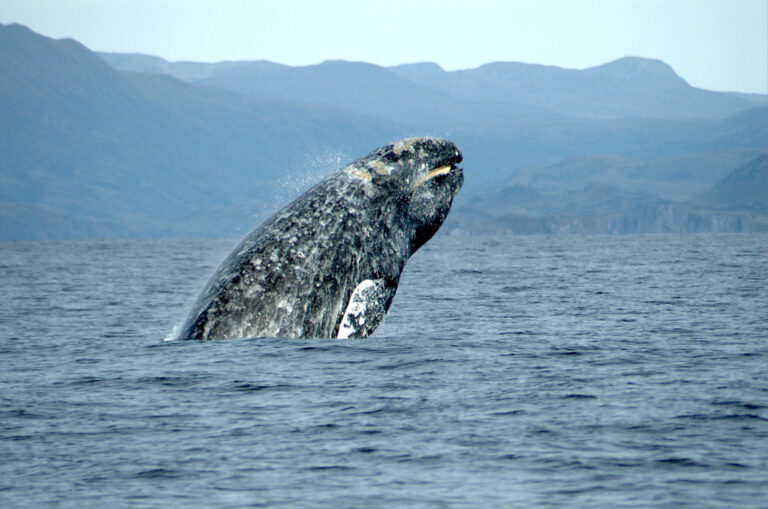
Humpback song covers a broad band of frequencies, up to several kilohertz, and humpbacks tend to gather in shallow coastal water. Both limit how far the full song can be detected to a few tens of kilometres, compared with hundreds for fin and blue whale calls. A song may run 5 to 15 minutes before it repeats, and adult males sing it during the breeding season. Tyack writes that the songs advertise readiness to compete with other males and to mate with females.
Humpback song also travels in a second sense. Males copy what they hear, so the song changes through a season. A study of six South Pacific breeding grounds found that new song types spread eastward like cultural ripples across an 11 year record, from eastern Australia toward French Polynesia, a span of about 6,000 km. Each new song took 2 to 3 years to make the full crossing. Our sister site explains more in why whales sing.
Tyack also stresses how little is known about range when whales are the listeners. The best field observations are fin whales, seen from a plane, swimming fast toward a feeding group 10 km away, and a humpback making a beeline for an active group 9 km away. For more on the biggest singers, see our Ocean Giants guide.
Elephant rumbles and the evening air
Elephants use sounds below 20 hertz, under the range of human hearing. A 2012 study filmed an excised elephant larynx at high speed and showed the vocal folds vibrate on their own as air flows past, the same mechanism as human speech and song.
Range depends heavily on the evening. In Etosha the modelling put the best conditions 1 to 2 hours after sunset on clear, cold, calm nights, when ranges of over 10 km are likely. Wind shear makes calls highly directional, so a rumble may carry much farther in one direction than another.
Rumbles also carry identity. Playback experiments in Amboseli National Park, Kenya, showed that adult females could tell the calls of family and bond group members from those of other females. The researchers estimated that a female would need to know the contact calls of a mean of 14 families, around 100 adult females, to make the distinctions she did. Our elephant site goes deeper in elephant infrasound.
One hypothesis goes much further. Nine GPS-collared elephants tracked over seven years in northwestern Namibia changed their movements at about the same time when rain was falling more than 100 km away. The authors say the trigger is uncertain; infrasound from storms is one possibility.
Wolf howls: holding ground you cannot patrol
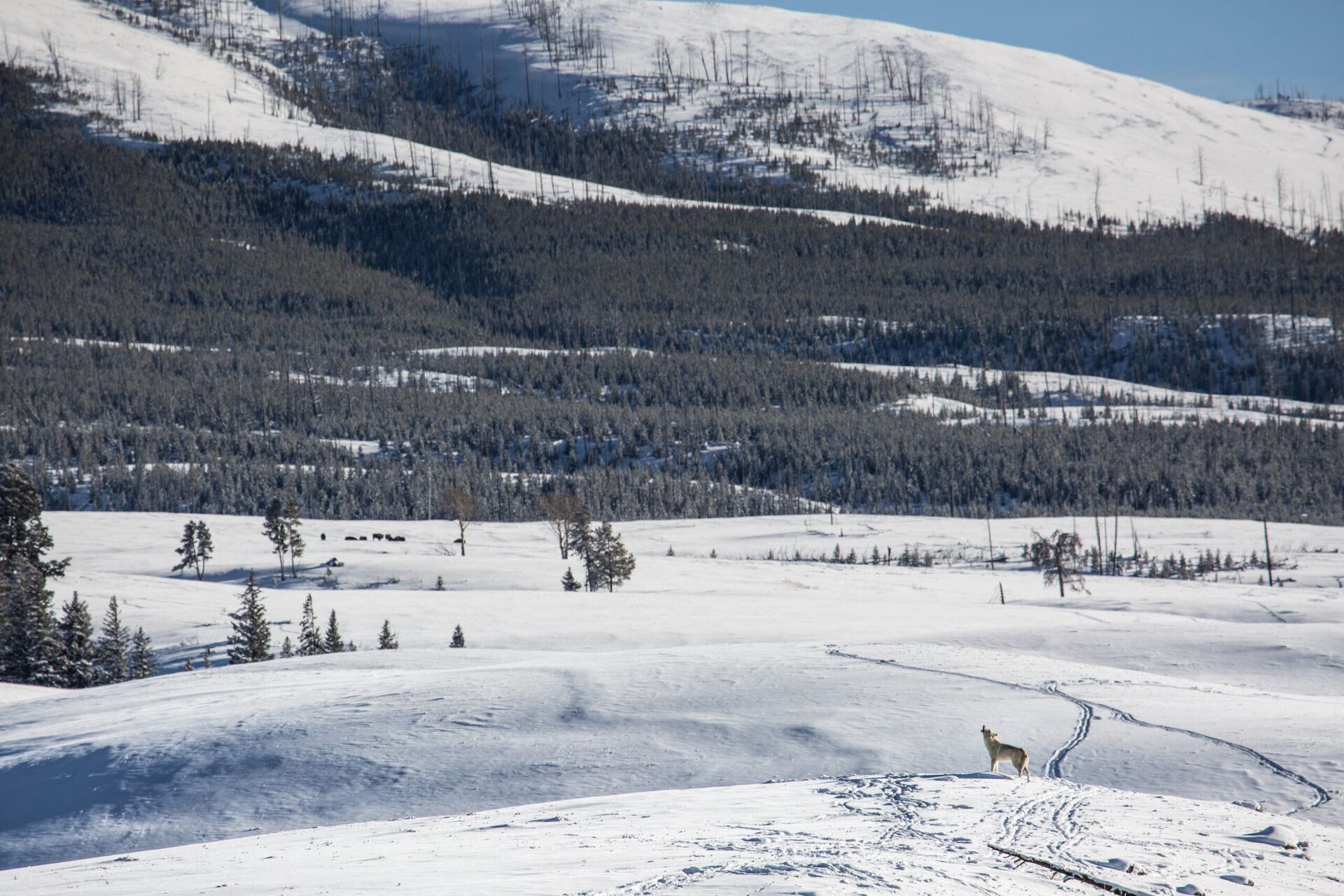
Wolves hold territories far too large to watch. A 2021 study of Indian wolves states that their howls can be detected over distances of more than 6 km. A classifier trained on 49 howls from five wolves named the right individual 98% of the time, and 75% (15 of 20) on a separate test set.
The classic field test of what howls do came from the Superior National Forest in Minnesota. Researchers howled at radio-collared wolves from eight packs and 10 lone wolves over two years and recorded who answered. Packs at a kill replied more often, and more so the more food was left. Larger packs replied more than smaller ones. Lone wolves without territories rarely replied.
The authors concluded that howling and scent marking work together. Scent marks are long-term and fixed to one spot. A howl is immediate and long-range. They judged howling most useful when two packs approach a shared border, and when a pack returns to ground it has not used for weeks and its scent posts have faded. Our wolves hub links to more on pack life.
Dolphin whistles: a name that carries
Bottlenose dolphin whistles sit much higher, roughly 2 to 20 kHz. Each dolphin develops its own signature whistle by about one year of age, and in females it stays stable for decades. By that age, mother and calf often separate out of sight for many minutes. Wild dolphins that separate are more likely to produce signature whistles, and they whistle faster at the point of greatest separation and as they reunite.
How far can a whistle reach? In the Moray Firth, Scotland, Vincent Janik measured whistles with a mean source level of 158 dB re 1 µPa and a maximum of 169. He estimated that an unmodulated whistle between 3.5 and 10 kHz at full volume could be heard 20 to 25 km away in 10 metres of water on a flat calm sea, and 14 to 22 km in rougher sea state 4. At 12 kHz the range dropped to 1.5 to 4 km. So dolphins that researchers count as separate groups might still be in acoustic contact.
What the whistle carries is a name, or the nearest thing to one. Dolphins extract identity from the whistle’s shape even when every voice feature has been removed. In a later field experiment, wild dolphins called back when they heard a copy of their own signature whistle, and ignored whistles that were not theirs. Our dolphin site covers the story in signature whistles.
What the four have in common
Here are the ranges side by side. Most are modelled or estimated detection ranges.
- Fin and blue whale calls: hundreds of kilometres, possibly 1,000 km or more in the deep sound channel.
- Humpback song, full band: a few tens of kilometres.
- Dolphin whistles: up to 20 to 25 km in calm, shallow water, much less at higher pitch.
- Elephant rumbles: over 10 km on a calm evening, much shorter by day.
- Wolf howls: more than 6 km.
The lowest calls go farthest, and every range shifts with conditions, from sea state for dolphins to night air for elephants and the deep channel for big whales. The jobs overlap too. Elephant and dolphin calls carry individual identity that other animals recognise, and wolf howls are distinctive enough for a computer to tell individuals apart. Wolves use howls to space packs apart. Humpback males use song in the breeding season. Our whales and elephants hubs collect the species posts.
The open question Tyack raises for whales applies to all four. We can measure how far a sound goes. Whether the animal at the far end hears it, knows the caller and acts on it is still being tested, mostly through playback experiments.
Have you heard wolves answer each other across a valley, or recorded whales or dolphins yourself? Add what you know in the comments.
Sources
- Tyack, P. L. (2017). Marine Mammal Acoustic Behavior. Acoustics Today, Summer 2017, p. 46 (also p. 47, p. 48, p. 49)
- Garland, E. C. et al. (2011). Dynamic horizontal cultural transmission of humpback whale song at the ocean basin scale. Current Biology
- Herbst, C. T. et al. (2012). How low can you go? Physical production mechanism of elephant infrasonic vocalizations. Science
- Garstang, M. et al. (1995). Atmospheric controls on elephant communication. Journal of Experimental Biology
- Larom, D. et al. (1997). The influence of surface atmospheric conditions on the range and area reached by animal vocalizations. Journal of Experimental Biology
- McComb, K. et al. (2000). Unusually extensive networks of vocal recognition in African elephants. Animal Behaviour
- Garstang, M. et al. (2014). Response of African elephants to seasonal changes in rainfall. PLoS ONE
- Harrington, F. H. and Mech, L. D. (1979). Wolf howling and its role in territory maintenance. Behaviour
- Sadhukhan, S., Root-Gutteridge, H. and Habib, B. (2021). Identifying unknown Indian wolves by their distinctive howls. Scientific Reports
- Janik, V. M. (2000). Source levels and the estimated active space of bottlenose dolphin whistles in the Moray Firth, Scotland. Journal of Comparative Physiology A
- Janik, V. M., Sayigh, L. S. and Wells, R. S. (2006). Signature whistle shape conveys identity information to bottlenose dolphins. PNAS
- King, S. L. and Janik, V. M. (2013). Bottlenose dolphins can use learned vocal labels to address each other. PNAS
Photo: Neal Herbert, Public domain, via commons.wikimedia.org.