
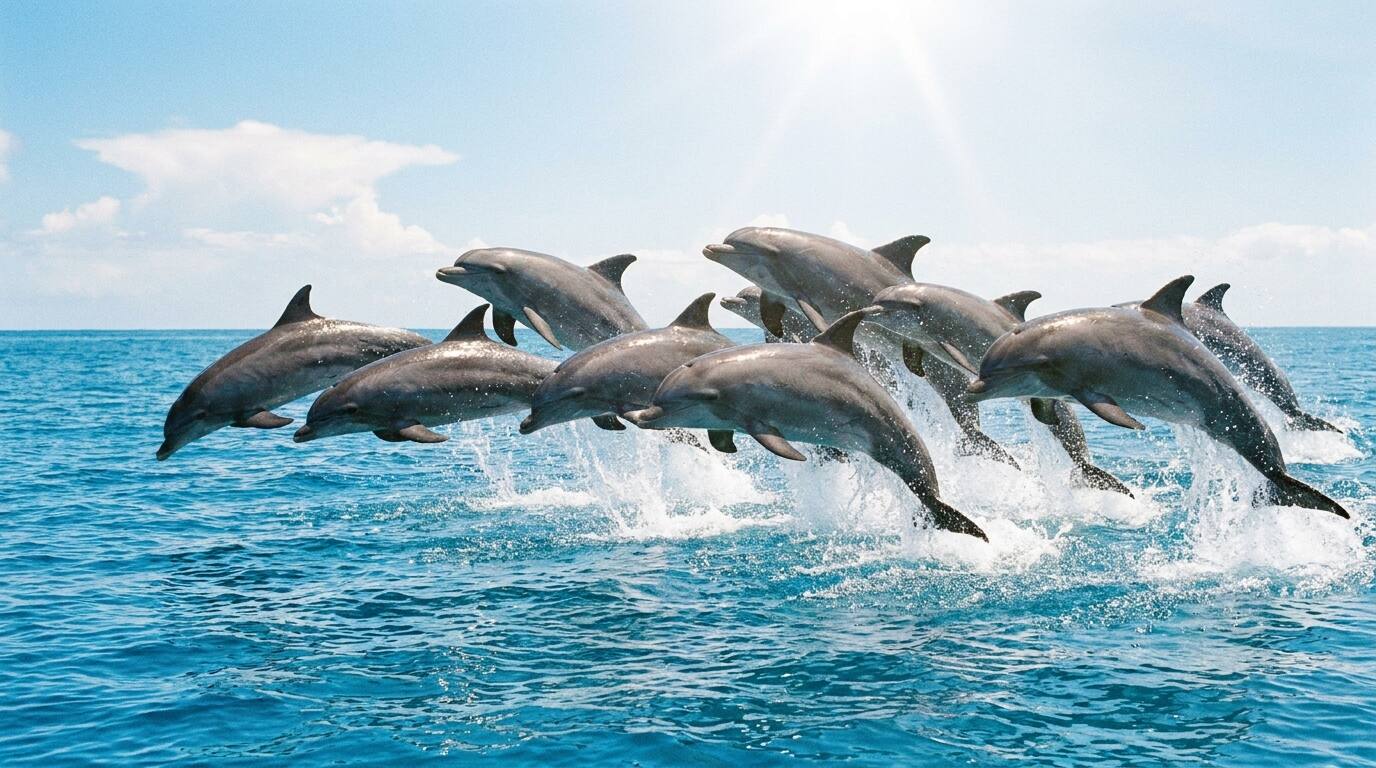
Dolphins
A clear introduction to dolphins: the main species, their intelligence and social life, and why bycatch threatens the most vulnerable populations.

Dolphins occupy a rare place in the way people feel about wild animals. They are quick, curious and visibly playful, and they seem to meet our gaze in a way few creatures do. That sense of connection is not a sentimental invention. Dolphins are genuinely intelligent, intensely social mammals with rich communication and behaviour that scientists are still working to understand. They are also, for the most part, doing reasonably well, which makes them a welcome contrast to many of the animals featured on this site.
This page is a broad introduction to dolphins as a group: what they are, the main types, how they live and how they are faring. It is an overview, not a complete reference. The detailed species profiles, behaviour features and conservation reporting live with our dedicated team at welovedolphins.org, who write about dolphins and nothing else. Use this page to get your bearings, then follow the links for the depth.
The dolphin at a glance
Dolphins are marine mammals and, technically, small toothed whales. They belong to the cetacean group alongside the great whales and porpoises, and they share the family traits: warm blooded, air breathing, and nursing their young with milk. What sets them apart is a combination of speed, sociability and intelligence.
- Size: ranges widely, from small species around 1.5 metres to the orca, the largest dolphin, which can exceed 8 metres.
- Range: oceans worldwide, from the tropics to colder seas, with several species living in major rivers.
- Diet: carnivorous, mainly fish and squid, with larger species such as the orca taking a much wider range of prey.
- Lifespan: many species live for several decades, and the longest lived can reach well beyond that.
- Social life: highly social, living in groups called pods, with cooperative hunting and strong bonds.
- Conservation: most species are listed by the IUCN as Least Concern, but a small number are critically endangered, mainly because of bycatch.
How many kinds of dolphin are there
There are around 40 species of dolphin, and they are more varied than the familiar image of a grey bottlenose leaping beside a boat. The bottlenose dolphin is the species most people picture, adaptable and found across much of the world’s warmer seas. But the group reaches well beyond it.
The orca, or killer whale, is the largest dolphin of all, a powerful and highly intelligent predator that lives in tight family groups. Spinner dolphins are named for the leaping, spinning displays they perform above the surface. Common dolphins travel in herds that can number in the thousands. There are also river dolphins, a distinct set of species adapted to fresh water, including the pink hued Amazon river dolphin. These river species tend to be among the most vulnerable, because rivers are heavily used and easily disturbed by people.
One point of confusion is worth clearing up. The vaquita, a small and critically endangered marine animal often mentioned alongside dolphins, is actually a porpoise, not a dolphin. Porpoises are close relatives but a separate group, generally smaller and blunter in the snout. For a proper species by species tour of the dolphin family, the field guides at welovedolphins.org go far deeper than this page can.
Where dolphins live and how they behave
Dolphins are found in oceans across the world, from warm tropical shallows to cooler coastal seas, and a handful of species live entirely in rivers. Some stay close to a particular coastline for life. Others range widely across open water in search of food.
It is their behaviour that draws the most attention. Dolphins are among the most social animals in the sea, living in pods that cooperate to hunt, defend one another and raise young. They communicate using a stream of clicks, whistles and other sounds, and they navigate and find prey through echolocation, building a picture of their surroundings from returning echoes. Bottlenose dolphins are known to use signature whistles that work much like names. Some populations have learned specific hunting techniques, such as herding fish into tight balls or driving them onto mud banks, and these methods are passed on within the group. This capacity for learning and culture is part of what makes dolphins so widely studied and so easy to admire.
Are dolphins endangered?
For the group as a whole, the news is relatively good. Most dolphin species are listed by the IUCN Red List as Least Concern, meaning they are not currently considered at high risk of extinction. Widespread and adaptable species such as the common bottlenose dolphin are doing comparatively well. That makes dolphins a genuine bright spot among marine mammals.
The picture is not uniform, though. A small number of dolphin species and populations are in serious trouble. The Maui dolphin, a tiny subspecies found only off part of New Zealand, is critically endangered with very few individuals remaining. River dolphins as a group face heavy pressure from dammed and polluted rivers. The single greatest threat to dolphins worldwide is bycatch: dolphins becoming accidentally caught and drowned in fishing nets and gear set for other species.
Most dolphins are not endangered, but the ones that are share a single problem: nets. Bycatch is the quiet, steady threat that turns a healthy population into a vanishing one.
Other pressures include pollution, underwater noise, habitat loss in coastal and river systems, and the broader effects of climate change on the fish dolphins depend on. Conservation work focuses heavily on reducing bycatch, through changes to fishing gear and methods, restrictions in sensitive areas and better monitoring. Organisations including WWF and the IUCN track the most threatened populations closely. The lesson from the most endangered dolphins is clear: a species can look common across most of its range while a single isolated population slips toward extinction.
Where to go next
If you want to know dolphins properly, the place to go is welovedolphins.org, our specialist blog devoted entirely to them. It carries species profiles, behaviour explainers, watching guidance and conservation features in much greater depth than a hub page can offer.
Dolphins also belong to bigger stories on this site. As small toothed whales they are close relatives of the great whales covered on our whales hub page. They share open water with the largest hunters and filter feeders in our pillar on ocean giants. And the orca, the largest dolphin of all, sits comfortably among the apex predators, the animals at the very top of their food webs.
Common questions about dolphins
Are dolphins whales?
In a technical sense, yes. Dolphins are small toothed whales, part of the same cetacean group as the great whales and porpoises. In everyday language we keep dolphins separate because of their size and behaviour, but biologically they sit firmly within the whale family.
How intelligent are dolphins?
Dolphins are widely regarded as among the most intelligent animals. They show problem solving, complex communication, social learning and behaviour passed between generations that resembles culture. Researchers continue to study how dolphin intelligence works rather than treating it as a settled question.
What is the difference between a dolphin and a porpoise?
They are close relatives but separate groups. Porpoises tend to be smaller, with blunter snouts and a different tooth shape, and they are generally less acrobatic. The critically endangered vaquita is a porpoise, not a dolphin, a distinction worth remembering.
Is the orca a dolphin?
Yes. The orca, often called the killer whale, is the largest member of the dolphin family. The name killer whale reflects its power as a predator rather than its classification. As a dolphin, it shares the group’s intelligence and strong social structure.
What is the main threat to dolphins?
Bycatch is the single biggest threat. Dolphins are drowned after becoming caught in fishing nets and gear set for other species. Most dolphin species are not endangered overall, but bycatch is the central reason the most threatened populations, such as the Maui dolphin, are in danger.
Shop the We Love Dolphins collection
Our sister site runs a dedicated dolphin shop: books, apparel and gifts chosen for dolphin lovers. Browsing it helps support the our conservation writing.
Visit the dolphin shopLatest from We Love Dolphins
Dolphin Senses: Taste, Smell and Electric Sense Explained
Dolphins have lost smell and most of their taste, yet they can recognise a friend by urine and sense weak electric fields. Here is what scientists found. The post Dolphin Senses: Taste,...
Read on We Love DolphinsHow Dolphins Breathe: Blowhole, Lungs and Oxygen
One sealed blowhole, a quick breath at the surface, and a body built to store oxygen. Here is how dolphin breathing works. The post How Dolphins Breathe: Blowhole, Lungs and Oxygen appeared...
Read on We Love DolphinsHow Dolphins Evolved from Land Mammals
The fossil steps from a hoofed wader to a whale with a tail fluke, and what each skeleton tells us about how dolphin ancestors left the land. The post How Dolphins Evolved...
Read on We Love DolphinsHow Scientists Tell How Old a Dolphin Is
Dolphins have no birth certificates. Here is how researchers read age from teeth, X-rays and decades of sightings, and why the method fails most for the oldest animals. The post How Scientists...
Read on We Love DolphinsHow Fast Can Dolphins Swim? Gray’s Paradox Explained
Bottlenose dolphins cruise at 3 to 6 km/h and sprint up to 30 km/h. A 1936 calculation said that should be impossible. Here is how it was settled. The post How Fast...
Read on We Love DolphinsDolphin Bubble Rings: How and Why They Make Them
Bottlenose dolphins blow air into spinning rings and play with them. Here is how they make them and what researchers think it means. The post Dolphin Bubble Rings: How and Why They...
Read on We Love Dolphins