
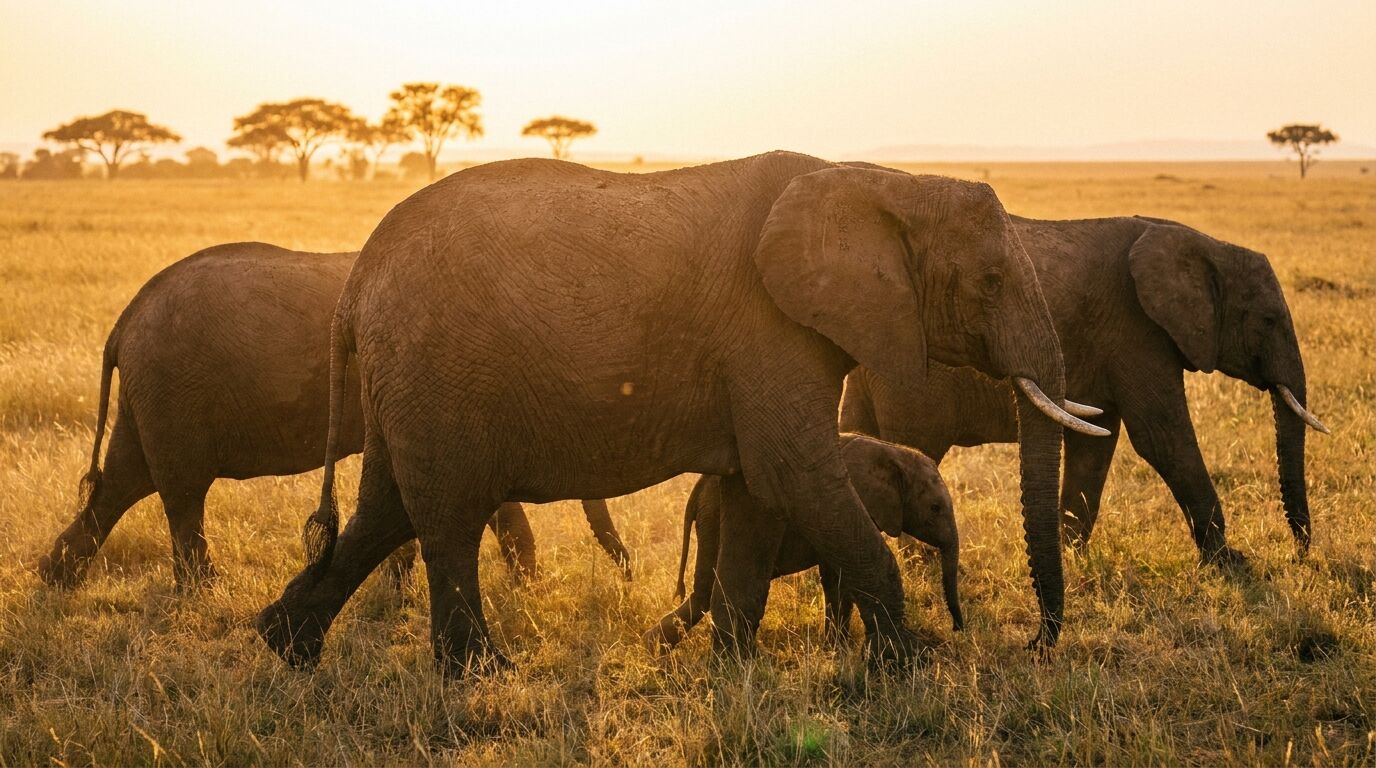
Elephants
Meet the three elephant species, learn how their family herds live, and see where they stand today on the IUCN Red List.

Elephants are the largest land animals alive today, and few creatures move people quite the way they do. They live in close family groups, recognise one another after years apart, appear to grieve their dead, and pass knowledge down through generations of females. For anyone curious about the natural world, elephants sit at a rare meeting point of size, intelligence and emotional depth, which is exactly why they turn up in so much of our folklore, art and conservation campaigning.
This page is a broad introduction: what elephants are, the species that exist, how they live, and where they stand today. It is a starting point rather than the last word. The deep, species-by-species coverage, the field stories and the regular news live on our dedicated sister site, loveelephants.org, and we will point you there whenever a topic deserves more room than a hub page can give it.
The elephant at a glance
Elephants belong to the family Elephantidae, the last surviving branch of a once far larger group that included mammoths and mastodons. Three living species are now recognised, all of them large, long-lived, highly social and heavily reliant on the trunk, a fusion of nose and upper lip that works as hand, hose, snorkel and signalling tool. A few quick facts set the scene.
- Size: African savanna elephants are the largest, with big bulls standing roughly three metres at the shoulder. Asian and African forest elephants are noticeably smaller.
- Range: across much of sub-Saharan Africa, and in scattered populations through South and Southeast Asia.
- Diet: entirely plant based. Elephants graze and browse on grasses, leaves, bark, roots and fruit, and a large adult can spend most of its waking hours feeding.
- Lifespan: commonly several decades in the wild, with some individuals reaching their sixties or beyond.
- Social life: females and young live in family herds led by an older matriarch, while adult bulls are largely solitary or move in loose bachelor groups.
- Conservation: all three species are listed as threatened by the IUCN Red List, with African forest elephants in the most serious category.
Three species, not one
For a long time elephants were usually split into just two species, African and Asian. That picture has now changed. Since 2021 the IUCN has assessed Africa’s elephants as two distinct species: the African savanna elephant and the African forest elephant. Genetic and physical differences between them are large enough that treating them as one was masking very different conservation realities.
The African savanna elephant is the giant of open grassland, woodland and semi-desert, the animal most people picture when they think of an elephant. It has large, outward-curving tusks in both sexes and the broad, fanned ears often compared to the shape of the African continent.
The African forest elephant is smaller and darker, with straighter, downward-pointing tusks and more rounded ears. It lives in the dense rainforests of Central and West Africa, where it plays an outsized role as a seed disperser, effectively gardening the forest as it moves. Because it is harder to count and slower to breed, its decline went underappreciated for years.
The Asian elephant is a separate species again, found from India and Sri Lanka across to parts of Southeast Asia. It is smaller-eared than its African relatives, and only some males carry prominent tusks while many, and nearly all females, do not. Asian elephants also have a long, tangled history with people, having been kept and worked alongside humans for thousands of years.
Where they live and how they behave
Elephants are ecosystem engineers. By pushing over trees, stripping bark, digging for water and trampling paths, they shape the landscapes around them in ways that benefit many other species. Forest elephants spread the seeds of large fruiting trees that few other animals can move, and savanna elephants help keep grasslands open. Remove elephants from a habitat and the habitat itself begins to change.
Their social world is built around the matriarch, usually the oldest and most experienced female. She holds the herd’s memory of where to find water in a drought, which routes are safe and how to respond to threats. Younger females help raise calves, and the bonds between related animals can last a lifetime. Elephants communicate over short and long distances using a wide range of sounds, including low rumbles that travel further than human hearing can follow, as well as touch, scent and body posture.
That intelligence is well documented. Elephants use tools, solve problems, show clear signs of self-awareness and behave in ways that look a great deal like grief, lingering over the bones of dead companions. They also need a lot of space. A single herd can range over a wide area in search of food and water, which is part of why habitat loss hits them so hard, and why conflict with farming communities is such a difficult issue.
Are elephants endangered?
Yes, and the detail matters. According to the IUCN Red List, the African savanna elephant is classified as Endangered and the African forest elephant as Critically Endangered, the more severe of the two categories. The Asian elephant is also listed as Endangered. In other words, every living elephant species is considered threatened, and the forest elephant in particular has seen a steep, sustained decline.
The threats are familiar but stubborn. Poaching for ivory remains a serious problem, especially where enforcement is weak. Habitat loss and fragmentation are arguably the bigger long-term pressure: as forests and grasslands are converted to farmland and settlement, elephant ranges shrink and break apart. That brings elephants and people into closer contact, and human-elephant conflict, ruined crops, damaged property and sometimes deaths on both sides, can quickly erode local goodwill towards conservation.
Saving elephants is rarely just about the animals. It is about water, land use, ivory markets and whether people who live alongside elephants see a reason to keep them there.
There is real work underway. Anti-poaching patrols, better-protected reserves, wildlife corridors that reconnect fragmented habitat, community programmes that share the benefits of tourism, and international restrictions on the ivory trade have all helped in places. Some populations are stable or recovering where protection is strong. The honest summary is that elephants are not doomed, but their future depends on sustained effort, funding and political will. You can read more about the bigger picture on our endangered animals and wildlife conservation pages.
Where to go next
This page is a doorway, not the whole house. If you want to go deeper, our specialist team at loveelephants.org covers elephant behaviour, individual species, conservation news and field stories in far more detail than a hub page can. It is the place to head when a single fact here leaves you wanting the full chapter.
It is also worth following the threads outward. If you found the matriarch-led family structure interesting, our pandas hub looks at a very different conservation story, one widely seen as a success. And if elephants drew you in because of their size and presence, our whales hub introduces the only animals on Earth that dwarf them.
Common questions about elephants
How many species of elephant are there?
Three living species are currently recognised: the African savanna elephant, the African forest elephant and the Asian elephant. The split of Africa’s elephants into two species is relatively recent, reflected in IUCN assessments from 2021 onward.
What do elephants eat?
Elephants are herbivores. They feed on grasses, leaves, bark, roots, branches and fruit, and a large adult needs to eat for much of the day to sustain its bulk. Forest elephants in particular eat a lot of fruit, which makes them important seed dispersers.
Why are elephants important to their habitats?
They are ecosystem engineers. By feeding, moving and dispersing seeds, elephants keep grasslands open, help forests regenerate and create water sources that other animals use. Their presence shapes the whole landscape, so losing them changes far more than one species.
Do all elephants have tusks?
No. In African elephants both males and females usually have tusks. In Asian elephants only some males carry prominent tusks, and many males and nearly all females do not. Tusks are enlarged teeth, and elephants use them for feeding, digging and defence.
How long do elephants live?
Elephants are long-lived animals. In the wild many reach several decades of age, and some individuals live into their sixties. Their long lives are one reason matriarchs are so valuable, since they carry decades of accumulated knowledge for the herd.
Shop the Love Elephants collection
Our sister site runs a dedicated elephant shop: books, apparel and gifts chosen for elephant lovers. Browsing it helps support the our conservation writing.
Visit the elephant shopLatest from Love Elephants
Can Elephants Run? What Gait Measurements Show
Elephants never leave the ground at once, yet they bounce on springy legs at speed. Here is what the measurements say about their gait and top pace. The post Can Elephants Run?...
Read on Love ElephantsElephants as Seed Dispersers: How They Plant Forests
Forest elephants carry seeds up to 57 km and some African trees barely regenerate without them. Here is what field work from Congo to Sri Lanka has found. The post Elephants as...
Read on Love ElephantsTuskless Elephants: How Poaching Changed Gorongosa’s Herd
After Mozambique's civil war, about half the surviving females in Gorongosa were born without tusks. Here is what the Science study found and what it means. The post Tuskless Elephants: How Poaching...
Read on Love ElephantsElephant Evolution: Mammoths, Mastodons and Living Elephants
What ancient DNA says about how living elephants relate to mammoths and mastodons, from a 3 kg ancestor to hybrid herds and the last mammoths on Wrangel Island. The post Elephant Evolution:...
Read on Love ElephantsHow Forest Elephants Raise Rainforest Carbon Storage
Forest elephants thin out light-wooded trees and spread the seeds of dense ones. Two studies put the carbon cost of losing them at about 6 to 9 percent of aboveground stocks. The...
Read on Love ElephantsHow an Elephant Calf Grows Up, Stage by Stage
What studies of wild and captive herds found about the first years of an elephant calf: who raises it, the stages it passes through, and what happens when it loses its mother....
Read on Love Elephants