
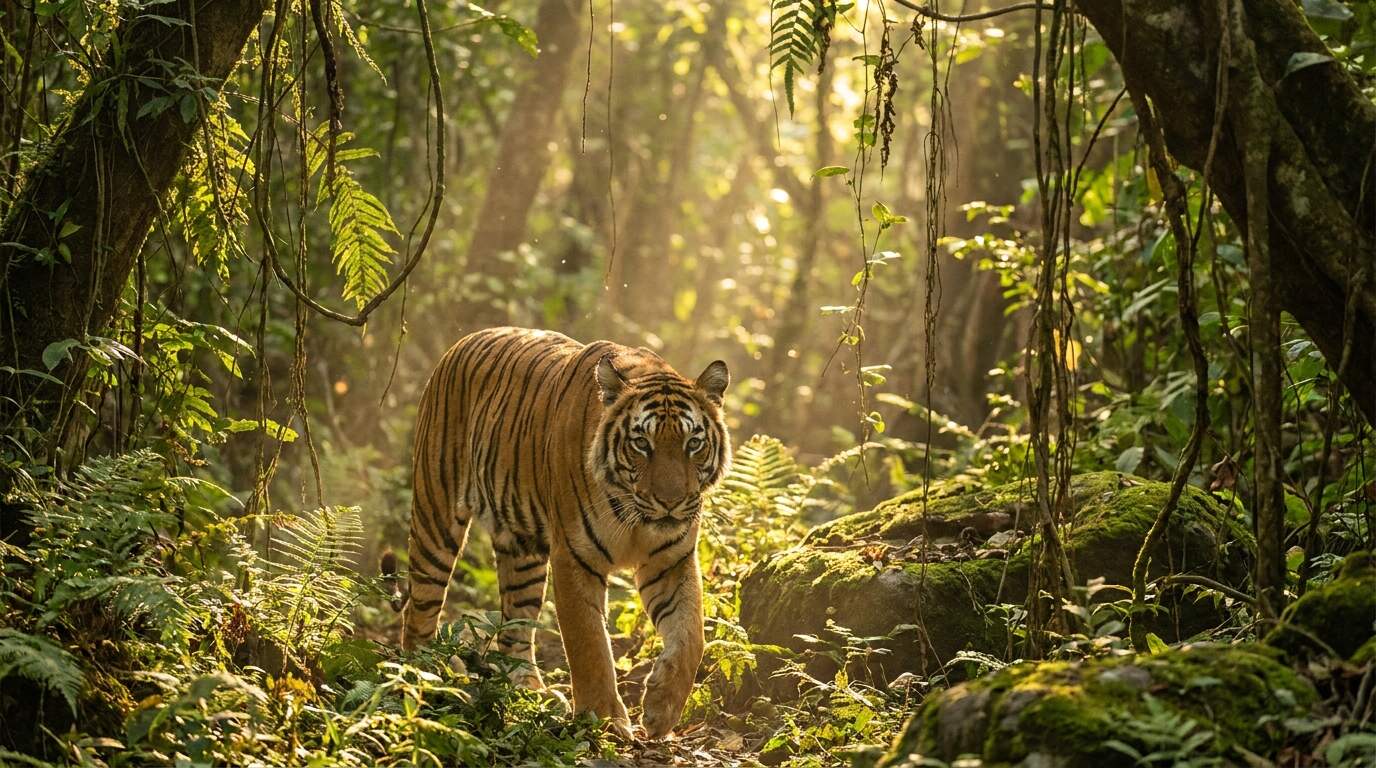
Tigers
A clear overview of tigers: the six surviving subspecies, where they live, how they hunt, and what their endangered status actually means today.

Few animals carry the same weight in the human imagination as the tiger. It is the largest of the living cats, a solitary hunter built for forests and grasslands across Asia, and a species that has become a kind of shorthand for the wider crisis facing wildlife. When governments talk about saving forests, when conservation groups campaign for stricter trade laws, when a national park raises its profile, a tiger is usually somewhere in the picture. That mix of power, beauty and vulnerability is what keeps people reading about them.
This page is the broad overview of tigers on We Love Wildlife. We cover what they are, where they live, how the six surviving subspecies differ, and where their conservation actually stands in the mid 2020s. For deeper species level coverage, behaviour notes, photography and the slower stories from the field, our dedicated team at welovetigers.org handles that work, edited by Sasha Amur.
The tiger at a glance
Tigers (Panthera tigris) are one species, with several living subspecies adapted to very different climates, from snowbound Russian forests to humid Sumatran rainforest. They are unmistakable: orange or pale gold coats with vertical black stripes that work as camouflage in tall grass and dappled woodland, and a build heavier than any other living cat.
- Size: the largest cats in the world. Big males in the Russian Far East can exceed 250 kg, while Sumatran tigers are roughly half that weight.
- Range: fragmented populations across parts of India, Nepal, Bhutan, Bangladesh, Myanmar, Thailand, Malaysia, Indonesia (Sumatra) and the Russian Far East. Historic range stretched from eastern Turkey to the Korean peninsula and Bali.
- Diet: pure carnivores. Deer and wild pigs are the staples, supplemented by larger prey like gaur and water buffalo where available.
- Lifespan: typically 10 to 15 years in the wild, longer in captivity.
- Social structure: solitary and territorial, except for mothers raising cubs.
- IUCN Red List status: Endangered as a species, with some subspecies in worse shape than others.
- Wild population: roughly 5,500 in the early 2020s, up from a low near 3,200 in 2010.
The six surviving subspecies
Most authorities recognise six living tiger subspecies. They share the same basic body plan but diverge in size, coat and habitat. Three further subspecies, the Caspian, Javan and Bali tigers, were driven extinct during the twentieth century. Understanding where each surviving population sits geographically helps make sense of the conservation picture.
- Bengal tiger. The most numerous subspecies, found mainly in India, with smaller populations in Nepal, Bhutan and Bangladesh. India alone holds the large majority of the world’s wild tigers.
- Indochinese tiger. Scattered across mainland Southeast Asia. Numbers are low and parts of its former range (Cambodia, Vietnam, Laos) are functionally empty.
- Malayan tiger. Confined to the Malay Peninsula. Population is critically low and continues to slide under heavy poaching pressure.
- South China tiger. Almost certainly extinct in the wild. A captive population is maintained in Chinese facilities, but no verified wild sighting has been confirmed for decades.
- Sumatran tiger. The smallest living tiger, restricted to the Indonesian island of Sumatra. Severely pressed by deforestation, especially for palm oil and pulpwood.
- Amur tiger. Also called the Siberian tiger. The largest tiger, adapted to the cold forests of the Russian Far East and adjacent northeast China. Slowly recovering after near collapse in the twentieth century.
Where they live and how they behave
Tigers are more flexible about habitat than their reputation suggests. They turn up in mangrove swamps (the Sundarbans, shared between India and Bangladesh), dry tropical forest, evergreen rainforest, grassland and the boreal taiga. What they need is cover, water, and enough large prey animals to sustain a population. Where any of those fail, tigers vanish quickly.
They are solitary and territorial. An adult male holds a range that overlaps with several females, and patrols its edges with scent marking and scrape marks rather than constant patrolling. Females raise cubs alone over roughly two years, teaching them to hunt before pushing them out to find their own ground. Tigers hunt by stalk and ambush, relying on stripes and silence to close to within a few metres before a short rush. Most attempts fail. The successful ones are typically against deer and wild pigs, occasionally something much larger.
As apex predators in their landscape, tigers shape the behaviour of every prey species below them, and through that pressure they shape the vegetation as well. Remove the tiger and the wider system shifts, in much the same way as removing wolves rewires a temperate forest or removing large bears alters a salmon stream.
Are tigers endangered?
Yes. The species is listed as Endangered on the IUCN Red List, and that single label hides a wide range of outcomes between subspecies. Bengal and Amur tigers are slowly recovering. Sumatran and Malayan tigers are in much worse shape. The South China tiger is, for practical purposes, gone in the wild. Across the global range, tigers occupy a small fraction of the habitat they covered a century ago.
The threats are familiar to anyone who follows endangered animals more broadly:
- Habitat loss and fragmentation, mainly from logging, agriculture (palm oil is a major driver on Sumatra) and infrastructure that cuts ranges into pieces too small to hold viable populations.
- Loss of prey. Even where the forest stands, hunting of deer and wild pigs by people can hollow it out until it cannot support tigers.
- Poaching for body parts. Skins, bones and other parts feed an illegal trade that has driven catastrophic declines, particularly in Southeast Asia.
- Human wildlife conflict. Tigers that prey on livestock or, very rarely, on people are often killed in retaliation. Compensation schemes and better livestock management help, but only where they reach the villages that need them.
There is a real recovery story alongside the losses. The wild population reached an estimated low of around 3,200 in 2010, when 13 tiger range countries signed the St Petersburg Declaration with a target of doubling wild tigers by 2022. The doubling was not achieved globally, but the trend reversed. India, which holds the bulk of the world’s wild tigers, has roughly doubled its national population through stronger reserves, anti poaching units and steady investment in tiger habitat. Nepal made comparable gains. By the early 2020s, the global wild figure had climbed to roughly 5,500. The pattern is uneven (rising in some range states, still falling in others) but it shows that the trajectory is not fixed.
Tigers are a useful test case for wildlife conservation more generally: protect enough connected habitat, control hunting of both predator and prey, and a large, slow-breeding carnivore can come back, given time.
A tiger needs three things in roughly this order: cover, prey, and to be left alone. If a landscape provides all three, the tigers usually find their way back.
Where to go next
This page is the overview. For the species level work, including subspecies deep dives, reserve profiles, behaviour notes and field photography, head over to welovetigers.org. Sasha Amur edits the site and writes most of the longer features there.
If you came to tigers through the wider story of large land predators, our wolves hub is a natural next stop: a different continent, a different social system (packs, not solitary hunters), and the same long argument about how human landscapes can keep big carnivores. The bears hub covers the other side of the large mammal coin, with eight species spanning Arctic ice to tropical forest.
Common questions about tigers
How many tigers are left in the wild?
Estimates put the global wild population at roughly 5,500 in the early 2020s, up from a low near 3,200 in 2010. The number varies between sources and is genuinely uncertain (tigers are hard to count) but the overall direction is cautiously upward, driven mainly by gains in India and Nepal.
What is the largest tiger?
The Amur tiger, often called the Siberian tiger, is the largest living subspecies on average. Big males in the Russian Far East can exceed 250 kg. Bengal tigers can also reach impressive sizes, and the two are close enough that exact rankings depend on the sample being measured.
Are white tigers a separate species?
No. White tigers are Bengal tigers with a rare recessive coat colour. They occur naturally on occasion in the wild but are extremely rare. Most white tigers in captivity descend from a small founder line and are heavily inbred. They have no conservation value and are not a separate species or subspecies.
Do tigers attack people?
Rarely, but it happens. Most tigers avoid people. A small number, often old or injured animals unable to take normal prey, become dangerous. The Sundarbans mangroves are the one landscape where tiger attacks remain a regular feature of rural life. Across the wider range, the bigger risk to people is loss of livestock, and the bigger risk to tigers is the retaliation that follows.
Can tigers be brought back to places where they have gone extinct?
In principle, yes, and there are active conversations about reintroducing tigers to parts of Central Asia where the Caspian tiger once lived. The hard part is not the tigers, it is the prey base and the social agreement on the ground. If the habitat holds enough deer and wild pigs, and if local communities accept the return, tigers themselves are resilient enough to recolonise. Without those two foundations, no reintroduction lasts.
Shop the We Love Tigers collection
Our sister site runs a dedicated tiger shop: books, apparel and gifts chosen for tiger lovers. Browsing it helps support the our conservation writing.
Visit the tiger shopLatest from We Love Tigers
How Tigers Mate: Oestrus, Courtship and Timing
A tigress is receptive for only a few days at a time. Here is how tigers signal, court, mate and time a litter. The post How Tigers Mate: Oestrus, Courtship and Timing...
Read on We Love TigersTiger-Human Conflict: What Helps in Bardiya and Beyond
Tigers are recovering in Nepal's Bardiya National Park, and so is contact with villagers. Here is what the evidence says helps. The post Tiger-Human Conflict: What Helps in Bardiya and Beyond appeared...
Read on We Love TigersHow Many Types of Tigers Are There? Nine, Six or Two
Tiger experts count nine, six or two subspecies. Here is who counts what, why they disagree and why it matters for conservation. The post How Many Types of Tigers Are There? Nine,...
Read on We Love TigersTiger Teeth, Claws and Paws: How the Kill Kit Works
How a tiger's retractile claws, canines, carnassials, tongue and skull work together, and where sources disagree on canine length. The post Tiger Teeth, Claws and Paws: How the Kill Kit Works appeared...
Read on We Love TigersAre There Tigers in Sri Lanka, Mongolia or Korea?
Three places people ask about, three different answers. What the sources say about tigers in Sri Lanka, Mongolia and Korea, and where they are silent. The post Are There Tigers in Sri...
Read on We Love TigersHow Camera Traps Count Wild Tigers by Their Stripes
Every tiger has its own stripe pattern. Here is how researchers turned that fact and a few forest cameras into a way to count wild tigers. The post How Camera Traps Count...
Read on We Love Tigers