Do Apex Predators Have Predators? What Kills the Hunters
Our Apex Predators page defines an apex predator as an animal with no natural predators of its own once it is fully grown. That is a fair working rule. It also leaves an obvious question hanging. Adult great white sharks, tigers and wolves still die. So what kills the hunters?
The research points to four answers: a bigger or better organised predator, members of their own species, disease, and people. The weight of each one changes from species to species, and the last one outweighs the rest almost everywhere.
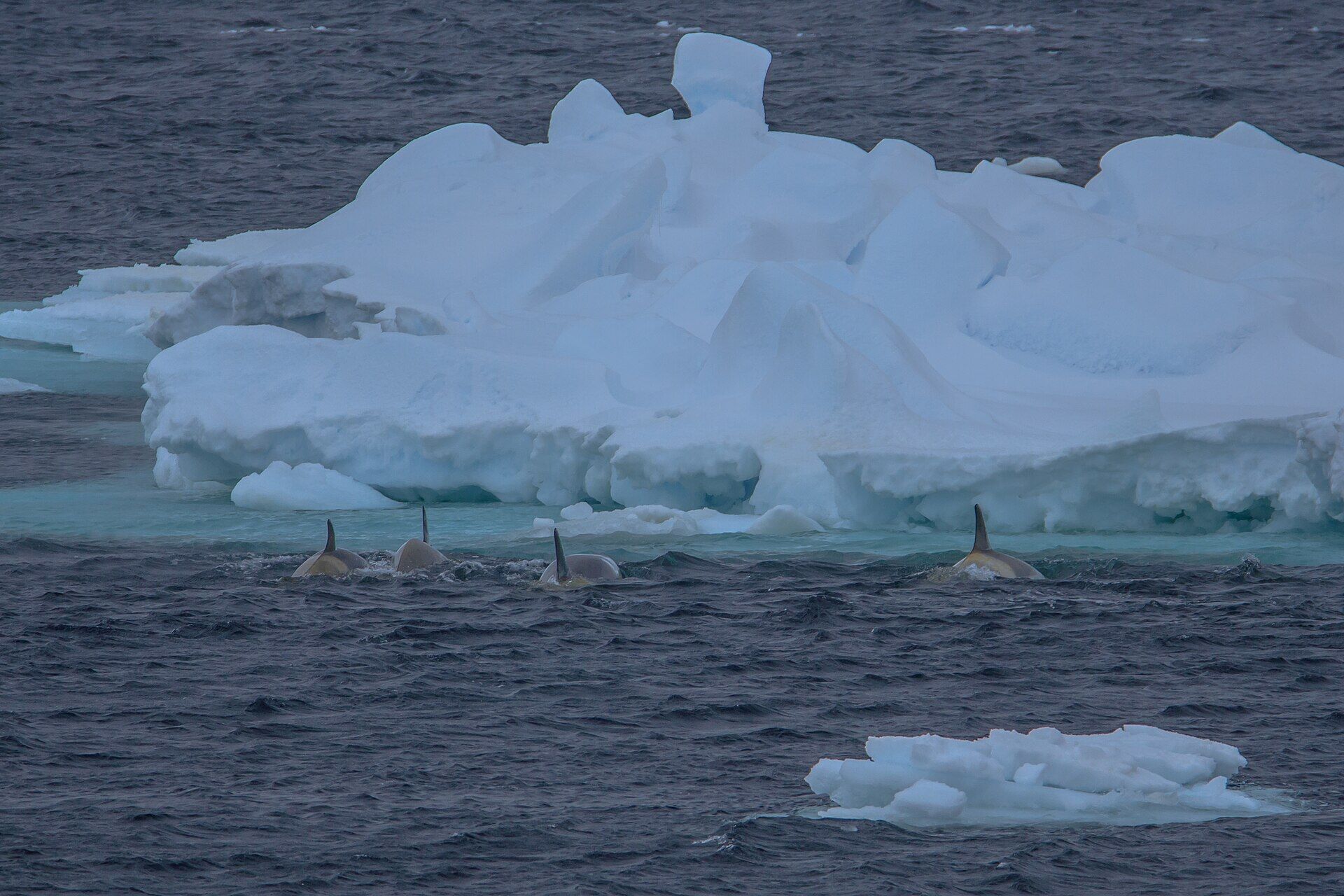
Orcas hunt great white sharks
The white shark is the textbook ocean apex predator, yet there is an animal it flees from. NOAA Fisheries calls the killer whale the ocean’s top predator, and in the last few decades scientists have caught it in the act of hunting white sharks.
The clearest early evidence came from tagged sharks off California. At Southeast Farallon Island, white sharks gather each autumn to hunt young elephant seals. On 2 November 2009, killer whales from two pods arrived while 17 tagged white sharks were in the area. Jorgensen and colleagues found that within seven hours and 50 minutes no tagged shark remained in range, and 16 of the 17 were not detected there again until the following season. The sharks moved to other sites, such as Año Nuevo Island, and seal kills by sharks at the Farallones dropped in years with close orca encounters.
South Africa then supplied the direct observation. On 16 May 2022, a drone pilot filmed five killer whales off Hartenbos Beach in Mossel Bay. One whale pushed a white shark of about 3 metres to the surface and bit into it. A helicopter pilot saw two white sharks killed by the whales that day, and photographed what looks like a whale swallowing a floating shark liver. One of the group was Starboard, a male already linked to earlier shark kills along that coast. The study that described it reports that cage diving boats, which had been seeing an average of 3.3 sharks per trip, saw none for 45 days afterwards.
The behaviour is not limited to one coastline. In October 2023 a 4.7 metre white shark washed up in southeastern Australia with its liver, digestive and reproductive organs missing. Swabs from the main bite wound carried killer whale DNA, and the authors suggest this kind of predation is more widespread than currently assumed. If you want the shark’s side of the story, our sister site has a longer piece on sharks versus orcas.
The threats NOAA lists for the orca itself are all human in origin: chemical contaminants, vessel noise and traffic, entanglement in fishing gear, food shortages and oil spills. Commercial hunting and culling were threats in the past, and live capture for marine parks remains a threat outside the United States.
Tigers and dholes
Across much of Asia the tiger shares its forests with the dhole, a wild dog that lives in packs. The dhole has a reputation as the one animal that can take on a tiger, so I went looking for the evidence.
The most thorough review I found pulled together 118 data sources on how dholes, leopards and tigers interact across Asia. Its conclusion was a clear pecking order. Tigers were dominant over dholes, although strength in numbers helped a dhole pack offset some of that. Leopards ranked below dholes. Tigers come out on top, and numbers are what let dholes push back at all.
That fits a wider pattern. A classic review of killing between carnivore species found that it accounts for up to 68% of known deaths in some species, that group-living species kill larger victims than solitary ones, and that in some pairings adults of one species kill only the young of the other. If that pattern holds for tigers and dholes, cubs would be the ones most at risk, though I found no data on it.
For the Amur tiger in the Russian Far East, other predators do not feature among the leading causes of death. A study that followed 57 radio-collared tigers from 1992 to 2012 found that poaching was the primary cause of death, followed by suspected poaching, then distemper, then natural or unknown causes. Poaching and suspected poaching together may remove 17 to 19% of the population each year. Our tiger blog covers how Russia has worked on that problem in its piece on the Amur tiger recovery, and our Tigers hub links to the rest.
Wolves kill wolves
With wolves, the main natural killer is other wolves. Yellowstone has some of the best long-term data on this. The park’s wolf page states that 65% of collared wolves are ultimately killed by rival packs. Packs are highly territorial, encounters between them are usually aggressive, and larger packs tend to beat smaller ones unless the smaller group has more old adults or adult males.
Researchers who watched 292 fights between packs in Yellowstone from 1995 to 2011 describe strife between wolves as the leading cause of natural death in the species. Wolves were more likely to give chase when they outnumbered the other pack, and males were more likely than females to chase rivals. Wolves also kill other carnivores, including coyotes and cougars, usually over territory or a carcass.
Bears come into the picture as rivals more than killers. In Yellowstone, brown bears often take carcasses away from wolves. The common assumption was that losing food to bears would push wolves to hunt more often, and a study across Yellowstone and Scandinavia tested it. The results pointed the other way, and where bears were around, wolves killed less often. The same paper points out a danger that is easy to forget. Wolves face a high risk of injury, or even death, when they hunt large prey that can fight back.
All of this shows up in lifespan. Yellowstone gives an average wolf lifespan of 4 to 5 years inside the park and an estimated 2 to 3 years outside it. Our wolf blog goes further into how long wolves live.
Disease reaches the top too
Being at the top of a food web does nothing to stop a virus or a mite. Canine distemper, a disease best known in domestic dogs, is the clearest example in big carnivores.
In Yellowstone, distemper outbreaks hit wolves in 2005, 2008 and 2009, and in 2005 it killed two thirds of the pups in the park. Sarcoptic mange, caused by a burrowing mite, reached epidemic levels among the park’s northern range wolves in 2009.
Amur tigers caught the same virus. After several wild tigers turned up with serious neurological disease, a team confirmed distemper as the cause in two of them and found infection in a third. They estimated that distemper directly or indirectly killed about 1% of Amur tigers in 2010, out of a wild population they put at fewer than 500 when the paper came out in 2013. A later study found that the virus circulates in several wild species, which matter more than dogs as the source of tiger infections. Vaccinating dogs alone would not protect the tigers, but vaccinating a small share of the tigers themselves would cut their extinction risk substantially.
People are the predator of predators
Several of the causes above come back to people. Poaching tops the list for Amur tigers. For orcas, the listed threats are pollution, noise, fishing gear and food shortages, all of them human.
For North American wolves the numbers are blunt. A review of 21 studies that followed the fates of 3,564 wolves recorded 1,442 deaths, and 61% of them were caused by people. Illegal killing made up 23%, legal harvest 16%, and removal by wildlife managers 12%. Where more natural habitat remained, a smaller share of the deaths were caused by people.
A wider study published in Science in 2015 compared 2,125 predator and prey interactions on land and at sea. As the Raincoast Conservation Foundation summarised it, people kill top land carnivores at 9.2 times the rate those carnivores kill each other, and take adult fish at 14.1 times the rate of other ocean predators.
So, do apex predators have predators?
For a healthy adult, mostly no, with exceptions worth knowing. White sharks have the orca. Wolves have rival packs, which kill far more wolves than any other wild animal does. Tigers outrank dholes. Disease reaches wolves and tigers alike. People outrank all of these in the numbers we have.
The human causes are also the ones people can change, and our Wildlife Conservation page covers the work being done on them.
Sources
- Jorgensen and colleagues, Killer whales redistribute white shark foraging pressure on seals, Scientific Reports (2019)
- Towner and colleagues, Direct observation of killer whales preying on white sharks and evidence of a flight response, Ecology (2023)
- Reeves and colleagues, Genetic evidence of killer whale predation on white sharks in Australia, Ecology and Evolution (2025)
- NOAA Fisheries, Killer Whale species page
- Srivathsa and colleagues, Topcats and underdogs: intraguild interactions among three apex carnivores across Asia's forestscapes, Biological Reviews (2023)
- Palomares and Caro, Interspecific killing among mammalian carnivores, The American Naturalist (1999)
- Robinson and colleagues, Mortality of Amur tigers: the more things change, the more they stay the same, Integrative Zoology (2015)
- National Park Service, Wolves, Yellowstone National Park
- Cassidy and colleagues, Sexually dimorphic aggression indicates male gray wolves specialize in pack defense against conspecific groups, Behavioural Processes (2017)
- Tallian and colleagues, Competition between apex predators? Brown bears decrease wolf kill rate on two continents, Proceedings of the Royal Society B (2017)
- Seimon and colleagues, Canine distemper virus: an emerging disease in wild endangered Amur tigers, mBio (2013)
- Gilbert and colleagues, Distemper, extinction, and vaccination of the Amur tiger, PNAS (2020)
- Hill and colleagues, Quantifying anthropogenic wolf mortality in relation to hunting regulations and landscape attributes across North America, Ecology and Evolution (2022)
- Raincoast Conservation Foundation, The human superpredator is unique and unsustainable, study says (on Darimont and colleagues, Science, 2015)
Have you seen a clash between two top predators, or read a study I missed? Tell us about it in the comments.
Photo: Murray Foubister, CC BY-SA 2.0, via commons.wikimedia.org.